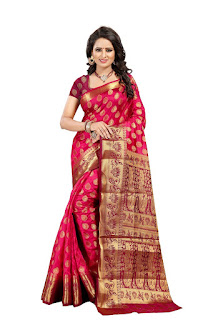
Buy Gaj gamini Bandhani Saree Online
SARI
The word "sari" has come into general use to cover
a generic category, including any draped untailored textile of about five
meters in length, worn by the bandhani saree Jamnagar of South Asia. In common parlance
outside the region, the term "sari" refers to an increasingly
standardized form of drape. More urban and cosmopolitan women have adapted the
Nivi style, but this drape is a relatively new phenomenon. In India alone,
around a hundred other forms of drapes continue to be worn. These vary from the
eight-yard Koli drape of bandhani saree jaipur in Maharashtra to the thrice-wrapped
drape of Bengal.
There is a bandhani saree pic belief that the sari as a draped and
seamless garment is the contemporary representative of the traditional female
attire of Hindu South Asia that became diluted by the introduction from the
North of tailored and stitched garments under the influence of Islam.
Historical and archaeological sources do not support this reading, however.
Representations on statues, wall paintings, and other sources suggests that for
as far back as there are records, women in the South Asia area wore a wide
variety of regional styles that included both stitched and unstitched garments,
tailored and untailored. Indeed in the twenty-first century, a bandhani sarees jodhpur is as likely to be associated with
Muslim women in the Bengal region as Hindus in the South of India. Furthermore,
the seamless piece of cloth of the sari is increasingly worn along with two
stitched garments, a full-length underskirt tied at the waist with a
drawstring, and a fitted waist-length blouse done up at the front. The sari
itself covers little of the body that is not already hidden by these
accompanying garments, although conceptually a bandhani saree price would see herself as unclothed without
the final addition. Most women also wear underwear to make a third layer of
clothing.
In the latter half of the twentieth century, the emergence
of the Nivi style of draping the sari may be attributed to middle-class women
entering the public sphere during the struggle for independence. It was
considered more bandhani saree red colour to public appearances and greater
mobility. This style consists of the sari being wrapped around the lower body
with about a meter of cloth pleated and tucked into the waist at the center and
the remainder used to cover the bosom and then falls over the left shoulder.
The loose end of the sari that hangs from the shoulder is known as the bandhani saree latest design . Younger and less confident women or
those wearing the sari as a uniform (such as nurses, policewomen, or
receptionists) usually pin the pallu to their shoulder in carefully arranged
pleats. As a result of the development of this pan-Indian cosmopolitan drape of
the sari, the influence of local regional traditions of draping has declined in
urban spaces and has become either confined to being worn within the home or in
rural areas. The bandhani saree low price style of wearing the sari was further
popularized through its increased association with other pan-Indian phenomena,
such as the film industry and national politicians. As a result this has become
the style that is symbolic of India as a state and women's sense of themselves
as Indian (although it may also be found more widely in South Asia, in
Bangladesh and Nepal). As a result of this development, women in areas of India
where the sari was not traditional garb adopted the sari for specific formal
occasions such as weddings and important public events.
bandhani saree lace can be made of natural or synthetic
fibers, and can be woven on hand looms or power looms. Natural fibers such as
silk and cotton, which are also more fragile, are worn mostly by middle-and
upper-class women. They are named after the regions in which they are made such
as Kanchipuram, Sambhalpur, or Kota. Each style is associated with particular
weaves, motifs, and even colors. Some saris can be very ornate and may include
real gold wash on silver thread (zari) in their embroidery (though most zari
work in the early 2000s is nonmetal).

The Immortality of the Indian Saree
Over the past 6 centuries, a lot has changed in the world.
Fashion trends keep on changing — infact, what was considered fashionable in
the 70's of the west is no longer considered fashionable today. In India, there
have been thousands of bandhani leheriya saree , conquests by foreign rulers, changes
in cultures & rulers — and then some.
So What is The Saree?
A saree is a piece of cloth between 5 and 9 meters. It is
worn traditionally by all Indian women — and has a great cultural bandhani saree material . Said to be one of the most graceful
dress of women, it elegantly covers the woman’s entire body by showing genuine
curves in the most dignified way. No other dress is as competent as the saree.
A woman in India looks absolutely complete when draped in a saree, and equipped
with beautiful ornaments and a shimmering bindi on the centre of her forehead.
Goddesses in Indian religions have been adorned with sarees.
Infact, new bandhani saree are even considered as a sacrificial
offering to many goddesses.
Its Significance
The real significance of the bandhani saree online purchase lies in the management of such a huge
piece of cloth in an aristocrat way. Sarees are usually linked with the
managing abilities of a woman, just like how she manages so many important or
trivial chores in a perfect fashion while being at it. Women look most refined,
polished, charming, and lovely while performing their chores while at the same
time, creating a harmony wherever they are.
Now days, the meaning of bandhani saree of Gujarat has been changed as it is more related
with showing skin than concealing a woman’s body. Earlier it was worn to hide
the waist but now screening the waist line has become important to look
gorgeous. The lady is considered as more dazzling and striking when she wears
the saree in such a fashion.


Comments
Post a Comment