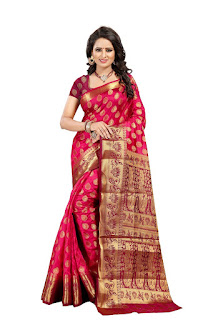
Buy Butta Pallu Bandhni Saree Online
Bandhani
The bandhani saree blouse pattern is a traditional garment worn by most
Indian women. Although at present there is a lot of western influence in the
way people dress. Today, sari comprises over 30% of total textile production in
India. Apart from large textile mills, the number of sari-manufacturing centers
are in hundreds and so the there are innumerable types of fabrics, weaving
techniques, methods of dying, printing or embellishing, designing patterns,
kind of motifs, color scheme etc. can be found There is something about the
sari that makes a bandhani saree bollywood look dignified, charming and every bit
stylish. Over the years, the sari has evolved into a fashion statement, which
most fashion designers glorify the look and feel of this traditional garment.
In this article an overview of traditional saris that are found in India have
been described in brief
History of Saris
The origins of bandhani saree cotton are obscure, in part because there are
very few historical records in India. Yet, we know that Indians were wearing
saris draped around their bodies long before tailored cloths arrived. The
origin of a sari can be dated back in history and there are various references
of it during the Indus Valley Civilization. In more recent times, it is
believed that the women in most parts of India have been wearing saris for many
years.
The Indian Sari is more than 5000 years old. It was first
mentioned in Rig Veda, the oldest surviving literature of the world, written
somewhere around 3000 BC. The Sari, originally intended both for men and women,
is probably the longest incessantly worn dress in the history of mankind.
One of the earliest depictions of a bandhani saree cost -like drape covering the entire body
dates back to 100 B.C. A North-Indian Terracotta depicts a woman wearing a Sari
wound tightly around her entire body in the trouser style.
This elaborate sculpture represented in the terracotta may
have evolved among India's temple dancers in ancient times to allow their limbs
freedom of movement while at the same time maintaining their bandhani saree design of modesty.
There are many sculptures of Greco-Indian Gandharian
civilization which show a variety of different Sari draping styles.

Tailored clothes arrived in India with the arrival of
Muslims. Hindus believed that any cloth pierced by needles was impure.
It is commonly believed in India that petticoat or Ghagra
and the blouse or Choli which are worn under the Sari are later additions which
started with the coming of British in India. Increasing number of upper class
women in the early 20th century did adopt items of European style clothing as
the fitted blouse and slim petticoat. This was also adopted due to the fashion
of transparent chiffon Saris during that particular period. Some of the wives
of Indian Kings draped themselves in Saris that were made by Persian designers.
Key Elements of Saree Measurement
There are mainly 3 key elements in saree measurement
Saree Length
Pallu Length
Border Width
The blouse selection can be considered as the outside of
saree measurements. Now in days, most of the blouses are integrated within a bandhani saree colors as per required measurement.
Also, the petticoat is another important element while
wearing a saree. Though it is not part of saree measurement, necessary care
should be taken for petticoat measurements also.
Saree length
The length of sarees varies as per tradition and
regional trends. It can be somewhere between 4.5 to 8 meters in length. The
width is normally 1.2 to 1.5 meter. There is no hard and fast rule about its
dimensions. You can choose the size that you find the perfect for yourself.
Length and Width of a Saree Lace
Most of the bandhani saree catalogue now in days have inbuilt borders. But
some of the high-end sarees will have an option to add custom border lace.
You should also understand the difference between designer
sarees and normal sarees. A designer saree is usually expensive due to the
heavy ornamentation and embedded zari work. It is suitable for special
occasions such as weddings, parties, functions, etc. Whereas a normal saree is
best suited for daily wear due to the comfort and convenience they provide.
Pallu length
Pallu is the decorated end of the bandhani saree collection and you can drape it as per your choice. The length of the pallu
can also vary according to your taste. Covering your left shoulder , the pallu
down through your back down to the back of knees. Get it pleated earlier if you
want to save yourself from the unnecessary effort of pleating it every time you
drape your favourite bandhani saree dress or you can keep your Pallu plain or
unpleated to wear a rather sober look.

Nice article about silk cotton. A magical harmony of fabrics and features, our latest Poly-Cotton and Silk Cotton saree collection makes for the perfect 9 to 5 saree choice for women across all ages. Aside from blending the comfort of cotton with traits like being wrinkle-free and easy to drape, these drapes also come in delightful designs and palettes.
ReplyDeleteBridal Silk Sarees
Traditional Kanjivaram Sarees